The artboard is sampled as a texture, and everything happens to the coordinates before the sample: whole blocks jump sideways, thin rows tear, and the red and blue channels are read from slightly different places so every edge splits. A few frames of block-shuffle and a bright bar roll through on each burst. Between bursts the screen keeps a faint scanline and a hair of chromatic split, so it never looks like a still. In the course this is the GlitchScreen node that dismisses the start menu.
New to shaders? Read Rive Shaders Explained →
Screen Glitch on its own artboard in the library file, with the ShaderQuad node and the WGSL, Inputs for Strength, Rate. Copy the artboard into any Rive file.
Learn to write this one: Gameplay tier · Glitch the Logo →
More from the Scripting Course
See all →Noise, as a Rive file, on us
The Noise shader with the GPU Canvas node wired and the WGSL inside. Drop it into any Rive file and see how a shader lives there.
Every shader here, as a ready-to-drop Rive file
Play with all of them here. The library file, every shader on its own artboard, comes with the Scripting Course, next to the lessons and the Space Game it belongs to.
Other free Rive tools
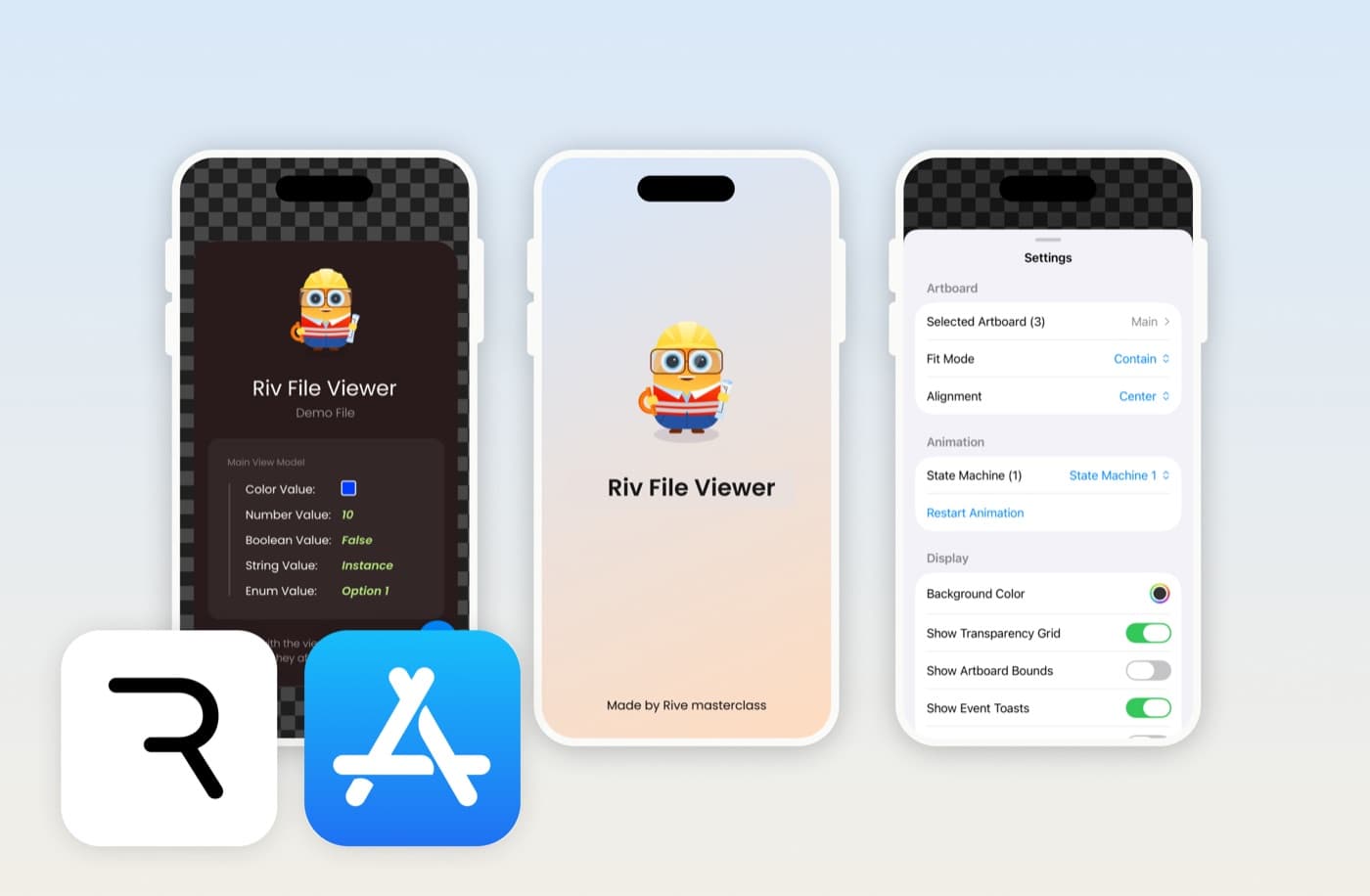
Riv File Viewer
Open, preview and debug .riv files on iPhone and iPad. Control state machines, edit data binding, and inspect assets.
Rive to Video Converter
Record a Rive animation playing and save it as a shareable mp4. Runs in your browser, nothing gets uploaded.
Embed Rive on Your Website
Paste a public .riv URL and copy an iframe embed code. Add a live Rive animation to any site, no SDK needed.